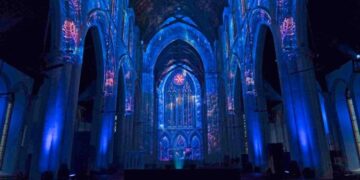









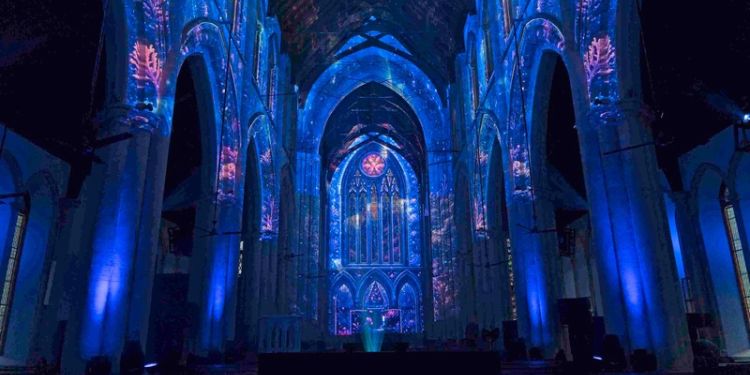
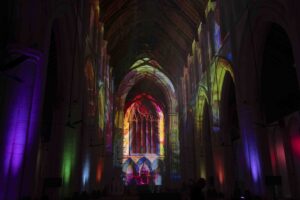
Church of St. John the Evangelist – popularly called the Afghan Church – in Mumbai recently dazzled in a rare spectacle of immersive projection mapping depicting a grand journey of ‘Ascension’ from earth to the Cosmos. In what turned out to be a brilliant demonstration of dexterity with imagery of light using projection mapping, two Mumbai-based domain expert enterprises Floating Canvas Company (FCC) and Synergy Technologies, came together to transform the interior of the 19th-century Gothic landmark into an immersive canvas of celestial imagery, animated light and vibrant colors.
SIAsia presents a snappy exclusive:
………………………………………………………….
Located at Navy Nagar in Colaba-Mumbai, the Afghan Church – officially known as the Church of St John the Evangelist – is actually an Anglican war memorial created in commemoration of the British and Indian soldiers who died in the First Anglo-Afghan War (1839–1842).
Built by the British East India Company between 1847 and 1858, the historic structure, with its characteristic spire taking seven more years to have final shape in 1865, also stands to commemorate the lives of soldiers who lost their lives in the Second Anglo-Afghan War that took place between 1878 and 1880.
An architectural splendour that it is, the church was designed by British civil engineer Henry Conybeare, with interior details like the reredos and tiles by William Butterfield, the then famous Gothic revival architect, and stained glass rendered by William Wailes. Its 198-foot spire served as a navigational beacon for ships entering Bombay Harbour.
While the tides of time relegated the Grade-I heritage building into negligence, an assiduous restoration initiative by the World Monuments Fund India with an estimated spending of ₹14 crore in early 2024, the church regained its old charm, and grandeur.
Now, a centre of attraction for visitors of guided tours as well as the regular Sunday Service, the Church again turned a glittering spectacle during the recent Mumbai Light Festival.
A special programme of Ascension was mapped to depict the essence of worship within the church, but with the surfaces of the spire playing the canvas for the spiritual journey depiction that it was.
Two Mumbai-based domain expertise leaders Synergy Technologies and Floating Canvas Company came together to execute this prestigious Ascension.
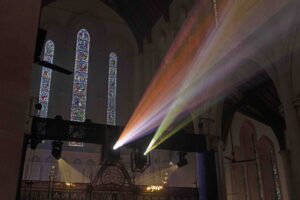
Synergy Technologies deployed eight Jazz Series DWU2400-JS projectors, six HS Series D23WU-HS 1DLP laser projectors, and a Griffyn 4K50-RGB pure laser projector. The Griffyn 4K50-RGB was selected to project onto the church’s central wall, the primary focal point of the show, where its exceptional brightness and pixel density delivered striking visual impact. The DWU2400-JS projectors illuminated the side walls and architectural features, while the D23WU-HS projectors were used for projections across the church’s expansive overhead surfaces.
Marking the first projection mapping installation inside a Grade I heritage structure in Mumbai, Ascension transformed the church’s soaring arches, vaulted ceilings and stained-glass windows with visuals inspired by a journey from earth to the cosmos, while respecting the character of the historic place of worship.

“The objective was never to overpower the architecture, but to work in harmony with it,” says Chirag Patel, founder of Synergy Technologies. “Every theme, motif and animation sequence was carefully developed to complement the church’s architectural details and allow the space itself to remain the anchor of the experience,” he explains. “We wanted audiences to appreciate the beauty of the building while becoming immersed in a visual journey through light and color.”
That the church remains an active place of worship, restraint was a key design consideration, underlines Chirag. “Instead of filling every surface with constant motion, we allowed moments of pause and focused attention on individual architectural details. This gave visitors time to appreciate the beauty of the space while becoming immersed in the experience.”
Given the depth of the event themed, the job required extensive planning and precision mapping. To make shape up the way it was intended, FCC conducted a detailed survey of the church and developed multiple digital masks to accurately map content onto the venue’s complex interior surfaces. The Griffyn 4K50-RGB and DWU2400-JS projectors were mounted on a truss at the rear of the church, and configured in portrait mode to provide optimal coverage of the side walls. The D23WU-HS projectors were installed along the church’s center aisle to project visuals across the vaulted ceilings.
The stained-glass windows presented a unique challenge, as glass naturally transmits rather than reflects light. FCC addressed this by carefully incorporating the color, texture and varying thickness of the stained glass into the visual design, enabling these distinctive elements to become an organic part of the overall presentation.
Rather than presenting visuals on an exterior façade, the installation unfolded around the audience, placing visitors at the center of the story. Clouds, stars and drifting light moved seamlessly across the church’s interior, creating moments of wonder and reflection while drawing attention to features that are often overlooked.

“FCC has once again demonstrated how projection mapping can transform spaces into extraordinary storytelling environments,” said Rishubh Nayar, ProAV sales director for India, Christie. “The successful realization of Ascension inside one of Mumbai’s most treasured heritage landmarks underscores the versatility, brightness and color performance of our projection technologies. We are delighted that FCC trusted Christie solutions to bring this unique experience to life and create a memorable visual spectacle for festival audiences.”