











AV integrators are no longer mere hardware suppliers and installers. Software-driven application layers built on top of hardware require AV system integrators to do much more than connecting cables and turning on the power of devices. With AI also now embedded into the devices, the necessity to go beyond physical connections and develop skills in application-level implementation is critical and mandatory.
However, the systems integrator cannot be expected to be a data scientist or cloud architect; the role remains grounded in system design and implementation, says Sachin Jain, Director of PLAY Technology.
In our continuing series of technical features on AI vis-à-vis AV, this issue we bring you another thought-provoking perspective provided by the PLAY Tech chief.
AV manufacturing OEMs have, for some time, been creating and enhancing their features on a range of products. Cameras use AI to provide speaker tracking, group framing, and active speaker detection. DSPs use AI for audio tuning, speech enhancement, etc. The list of devices and AI-enabled features just keeps adding up.
The OEMs may be creating a powerhouse within their products using AI. However, it’s the AVSI who needs to ensure that these features are configured and customised for the client’s space. Just like in an LLM model such as ChatGPT or Gemini, you need to be accurate in your prompts for more specific and better results; the AI features in an AV solution need to be set up accurately for the intended results. AI, when not prompted for specifics, will still behave in a semi-intelligent manner in standard mode, giving better than regular results. However, specialised configuration will drive enhanced experiences.
What this also means is that design intent is no longer limited to hardware selection and placement. The AVSI must now define how the system behaves under different real-world conditions. A camera with auto-framing capability may work out of the box, but in a boardroom with reflective surfaces, variable seating positions, and inconsistent lighting, default behaviour often falls short. The AVSI is required to step in not to build the AI but to shape its output through correct configuration, calibration, and environmental alignment.
This introduces a new layer of responsibility: context engineering. The performance of AI features is highly dependent on the environment in which they operate. Camera angles, mounting height, room geometry, acoustic treatment, background noise, and even furniture layout influence how effectively AI performs. The AVSI must therefore design not just for coverage, but for AI effectiveness. A poorly positioned device can render even the most advanced AI feature ineffective.
Further, AI features across devices do not operate in isolation. A typical meeting room today may include AI-enabled cameras, DSPs, and unified communication platforms, each making independent decisions. If not carefully aligned, these systems can create conflicting outcomes. For example, a camera may track one participant while the audio system enhances another, resulting in a disjointed experience. The AVSI’s role is to ensure coherent system behaviour across multiple AI engines, even when they originate from different OEMs.
This is where the shift from integration to orchestration becomes evident. The AVSI must map user workflows and align device behaviours accordingly. A meeting is no longer just a connection of audio and video; it is a sequence of interactions. Entry into the room, meeting initiation, speaker transitions, content sharing, and meeting closure must all trigger predictable and seamless responses from the system. AI features support these workflows, but they do not define them. That responsibility remains with the AVSI.
While meeting rooms are the most immediate and widely adopted examples of AI-enabled AV systems, the same principles extend across other types of spaces such as auditoriums, museums, and customer experience centres (CEC). In these environments, AI does not simply automate predefined actions, but introduces systems that interpret, predict, and respond based on data inputs. This fundamentally changes how AV systems behave and, in turn, how they must be implemented.
In auditoriums, AI-enabled systems such as presenter tracking, transcription, translation and summaries based on the voice signature of the speaker or automated camera direction do not operate on fixed logic. Their performance depends on how accurately the system can interpret movements, voice, identify subjects, and prioritise focus. Variations in stage design, lighting conditions, number of participants, and audience interaction directly impact these outcomes. The AVSI must therefore configure these systems with a clear understanding of how the underlying models respond to different inputs. This includes defining tracking zones, tagging voice signatures with names, sensitivity thresholds, and behavioural priorities so that the system produces stable and predictable results despite changing conditions.
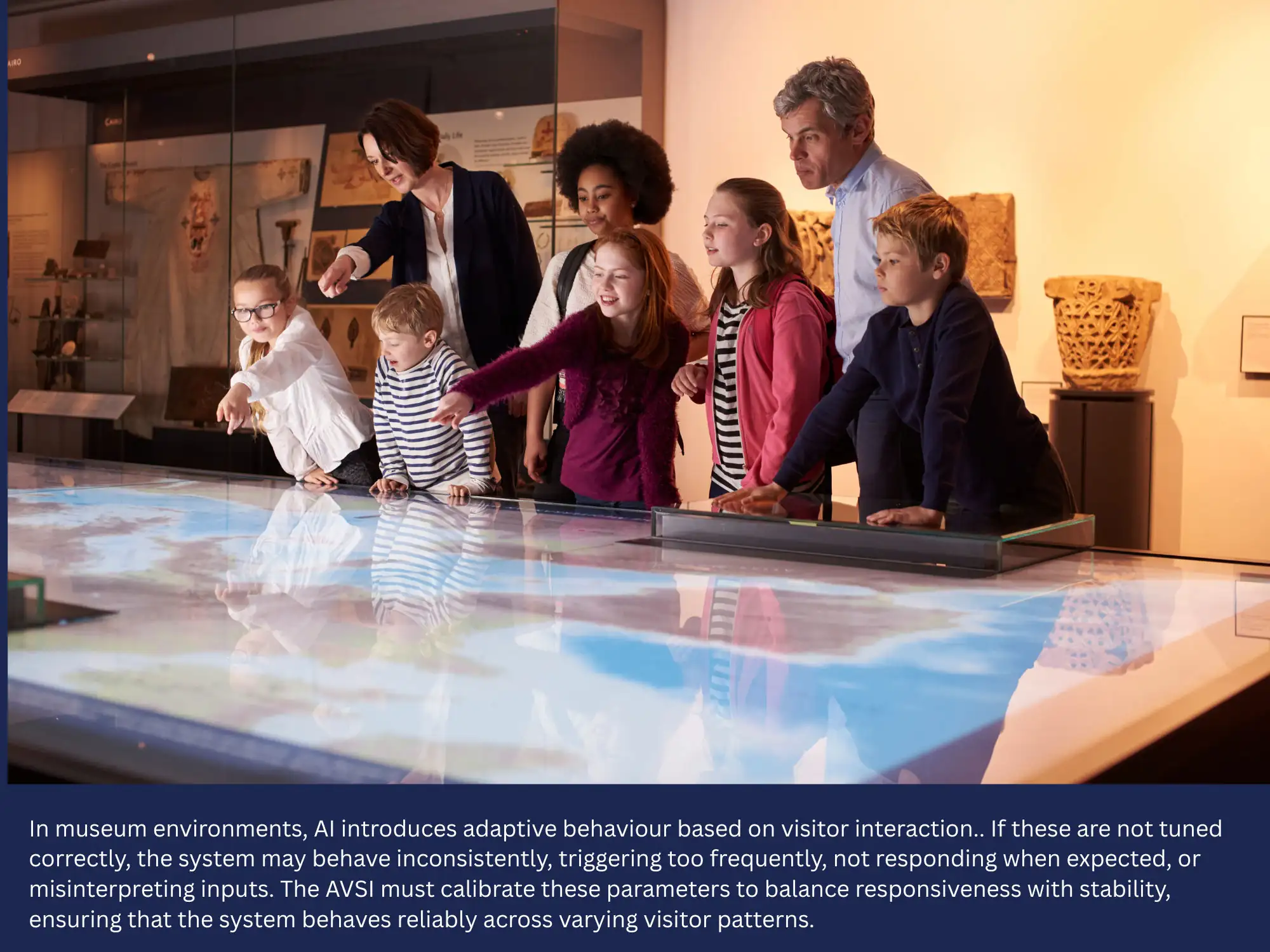
In museum environments, AI introduces adaptive behaviour based on visitor interaction. Systems may respond to presence, movement patterns, or engagement levels. However, unlike show-control or automation systems, AI-driven responses are influenced by probabilities and confidence levels. If these are not tuned correctly, the system may behave inconsistently, triggering too frequently, not responding when expected, or misinterpreting inputs. The AVSI must calibrate these parameters to balance responsiveness with stability, ensuring that the system behaves reliably across varying visitor patterns.
CECs further highlight the role of AI in interpreting user intent rather than executing predefined commands. Systems may adapt content, adjust presentation flow, or personalise interactions based on detected inputs. These behaviours are dependent on data quality and contextual relevance. The AVSI must ensure that inputs to these systems, whether visual, audio, touch or environmental, are accurate and consistent. Poor input quality leads directly to poor AI outcomes, regardless of the capability of the underlying system.
Across all these spaces, AI introduces a level of non-determinism that is fundamentally different from traditional AV systems. The same input may not always produce identical outputs, and system behaviour may evolve over time as models are updated or refined. The AVSI must therefore shift from expecting fixed responses to managing acceptable ranges of behaviour. The focus moves from ‘whether the system works’ to ‘does the system behave within expected limits’.
Another critical aspect is testing and commissioning. Traditional commissioning involved verifying signal flow, device response, and control logic. Instead of setting fixed parameters, the AVSI must tune systems iteratively; observing how AI features respond in real conditions and adjusting thresholds, zones, and priorities accordingly. In an AI-enabled environment, commissioning must extend to validating behaviour under dynamic conditions. Multiple participants speaking simultaneously, movement within the room, varying noise levels, and changes in lighting must all be tested. The AVSI is no longer validating whether the system works, but whether the experience remains consistent across scenarios. Commissioning becomes a process of refinement rather than validation, requiring multiple test scenarios to achieve consistent performance.
Another critical factor is input dependency. AI systems rely heavily on the quality of data they receive. Camera placement, field of view, lighting uniformity, microphone pickup, and background noise all directly influence how effectively AI models perform. The AVSI must ensure that these input conditions are optimised during design and implementation. Even the most advanced AI feature will underperform if the input conditions are not aligned with its operating requirements.
This introduces a continuous optimisation requirement that goes beyond traditional maintenance. In addition, AI-enabled systems are not static. Firmware updates, feature enhancements, and algorithm improvements continuously change how devices behave. These updates can alter system behaviour, sometimes improving performance and at other times requiring re-tuning. This introduces a lifecycle component that AVSI teams must be prepared to manage. Post-installation support will increasingly involve reconfiguration, fine-tuning, and optimisation of AI features rather than only troubleshooting hardware faults. The AVSI must be prepared to revisit configurations post-deployment, ensuring that system behaviour remains aligned with the intended outcome. The system delivered on day one will not remain identical over time, and the AVSI must take ownership of maintaining performance standards.
In these environments, the role of the AVSI is not to define logic, but to tune behaviour. AI provides the capability to interpret and respond, but it does not guarantee correctness in every scenario. The AVSI must bridge this gap by configuring, calibrating, and refining the system so that it performs reliably within the context of the space.
It is equally important to clarify that while AI introduces new dimensions, the systems integrator is not expected to become a data scientist or a cloud architect. The role remains grounded in system design and implementation. However, there is a clear expectation to be AI-aware to understand what the features do, what inputs they depend on, and how configuration impacts output. This awareness allows the AVSI to collaborate effectively with OEMs and IT teams without overstepping into their domains.
Ultimately, the shift is not about replacing existing AVSI skills, but about building on them. Fundamentals such as acoustics, sightlines, system design, and user experience remain critical. AI amplifies the importance of getting these fundamentals right. A well-designed room enhances AI performance, while a poorly designed one limits it.
The requirement to understand and tweak AI configurations is a skill set that the AVSI team will need to develop. AVSI will need to invest in upskilling their current teams with knowledge of IT and AI. These skills, which were confined to a certain section of the current teams, will be required to percolate down to the junior technicians as well in the upcoming years.
The requirement is to build practical, implementation-level understanding of how AI-enabled features behave within AV systems. Teams will need to understand how inputs influence AI outcomes. The ability to identify why an AI feature is not performing as expected, and to correct it through configuration and environmental adjustments, will become a core competency. Teams must be trained to test systems under varying conditions. Understanding how AI systems respond under these conditions, and how to stabilise that response, will be critical to delivering a consistent user experience.
The AVSI of today is therefore evolving into a system behaviour designer who ensures that technology does not just function, but functions intelligently, predictably, and in alignment with user expectations.

The author is Director at PLAY TECHNOLOGIES, one of the leading AV design consultancy and systems integration firms from Mumbai, and presence across IMEA regions. He can be contacted at Sachin.jain@playtechnologies.in