









 Esports production is evolving at a pace unmatched by traditional broadcast and live events. At the heart of this transformation are three defining pillars: flexibility, scalability, and innovation. As highlighted in Ross’s framework, these principles are no longer aspirational—they are operational necessities.
Modern esports arenas are not just venues; they are dynamic, high-performance ecosystems that must pivot between game titles, scale across event sizes, and continually adopt new technologies to meet rising audience expectations. Drawing on insights from Andrew Tan, Regional Sales Director, Asia, Ross Video, this article explores how these three pillars are embedded into the very DNA of esports production—and how they are shaping the future of AV in this space.
A New Kind of Venue: Built for Flexibility
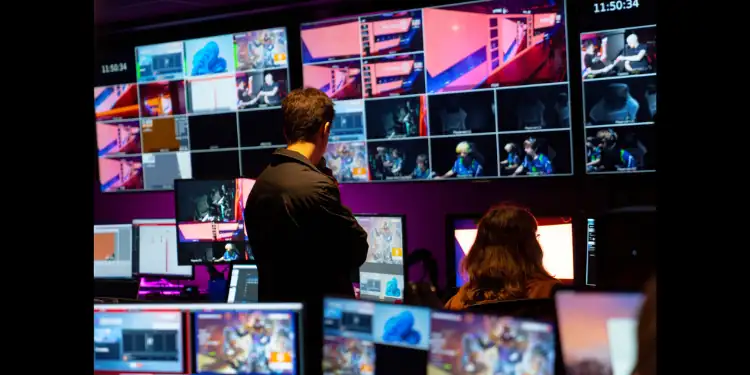
Esports arenas differ fundamentally from traditional sports or entertainment venues. Rather than supporting a single primary feed, they function as multi-layered content ecosystems, managing simultaneous inputs—from player POVs and caster cameras to live data overlays and analytical graphics.
This is where flexibility becomes critical.
Unlike conventional formats, esports events are highly volatile. A venue may host a first-person shooter tournament one day and a sports simulation or mobile game the next—each requiring entirely different production logic, visual priorities, and workflows. As Andrew Tan explains, “what matters” shifts with every title: the number of feeds, the type of data, and how that information is presented.
Facilities such as the Confetti X Esports Complex illustrate this reality. Designed to accommodate diverse game genres and event formats, the venue prioritises repeatable workflows and unified control systems. This allows operators to pivot quickly without rebuilding production from scratch—an essential capability in an environment where last-minute changes from developers and publishers are common.
Flexibility also extends beyond competition. The rise of the “esports campus” model—where venues support training, content creation, and community engagement—demands infrastructure that can seamlessly switch modes. In this context, AV systems are no longer static installations but adaptive platforms that enable continuous reinvention.
Scaling the Experience: From Boutique Events to Global Spectacles
If flexibility enables adaptation, scalability ensures sustainability.
Esports events range from small regional tournaments to global championships with millions of online viewers. For operators, the challenge lies in delivering high production value while maintaining cost efficiency—a balance that requires intelligent system design.
High-performance LED displays are a case in point. In esports, the main screen often serves as the audience’s primary “field of play.” This places immense importance on low latency, high refresh rates, and consistent colour reproduction. But as venues grow, the challenge shifts from optimising a single display to coordinating dozens—sometimes hundreds—of endpoints across the arena.
Andrew notes that the real breakthrough in large-scale deployments often comes not from adding more technology, but from reducing workflow fragmentation. By streamlining signal paths and aligning production with display systems, operators can maintain consistency across multiple outputs while meeting strict latency requirements.
Scalability also manifests in infrastructure. The shift towards AV-over-IP and broadcast IP workflows allows venues to move away from rigid, point-to-point connections. Instead, video, audio, and data become network-based resources that can be routed, scaled, and reconfigured as needed.
Andrew adds that when people refer to broadcast IP, they’re generally speaking about environments built around SMPTE ST 2110, where video, audio, and ancillary data travel as separate flows. In practice, this means three core building blocks: a switching fabric, ST 2110-capable endpoints and gateways, and an orchestration layer that enables devices to discover and connect flows. The infrastructure becomes more akin to a platform than a patchbay — and in larger deployments, that orchestration layer may extend to monitoring and debugging across complex topologies. It’s worth noting that this is not “plug and play” in the consumer sense; broadcast IP introduces new design priorities around timing, stream management, and control, making the venue resemble a purpose-built media network.
However, IP alone is not the solution. The real advantage lies in software-defined production, where processing, routing, and multiviewing are treated as flexible resources. This enables venues to build a core system once and adapt it across different event scales and formats—maximising both efficiency and return on investment.
Latency as the Invisible Decider: Engineering for Real-Time Precision
In esports, latency is not a background technical metric—it is a defining factor in both competitive integrity and audience experience. Even slight delays between gameplay, in-venue screens, and live streams can disrupt the sense of immediacy that fans and players rely on. As a result, manufacturers are approaching latency as an end-to-end challenge, focusing on minimising processing steps, streamlining signal paths, and ensuring tight synchronisation across switching, graphics, and replay systems. Crucially, the goal is not just ultra-low latency, but consistent and predictable performance. Since latency is cumulative—every conversion, scaling process, or handoff adds delay—system designers are prioritising cleaner, more efficient workflows. At the same time, there is growing recognition that latency and operational complexity must be addressed together. Fragmented systems with multiple control layers often introduce both delay and inconsistency, particularly in high-pressure live environments. The shift, therefore, is towards unified orchestration—where video, audio, and show control are tightly integrated—ensuring that the entire production ecosystem moves in sync, delivering a seamless and truly real-time experience.
Driving Innovation: Meeting the Expectations of a Digital-Native Audience

If flexibility and scalability are about capability, innovation is about relevance.
Esports audiences are among the most tech-savvy and demanding in the world. They expect not just high-quality visuals, but immersive, interactive, and constantly evolving experiences. This pushes production teams to rethink traditional workflows and embrace new technologies.
One major area of innovation is hybrid production. Esports events inherently combine in-venue experiences with global broadcast and online streaming. Today’s platforms are evolving to support this complexity, moving from single-output pipelines to integrated ecosystems that deliver multiple synchronised outputs.
Three key trends are shaping this evolution:
• Template-driven workflows: Standardisation enables teams to handle the variability of esports formats while maintaining consistency across events.
• Automation and data integration: Real-time game data is increasingly driving graphics and storytelling, reducing reliance on manual processes and enabling faster, more dynamic content delivery.
• Unified orchestration: Bringing together video, audio, lighting, and control into a single layer ensures that the arena and the broadcast feel like one cohesive experience.
Latency remains a critical frontier in this innovation cycle. In esports, even minor delays can disrupt both competitive integrity and audience immersion. As a result, manufacturers are focusing on end-to-end latency optimisation, minimising processing steps and improving synchronisation across systems.
But perhaps the most significant innovation lies in experience orchestration. As esports venues converge with themed entertainment and brand activations, production expands beyond screens into fully immersive environments—coordinating content, cues, and interactions across multiple touchpoints.
The Convergence of Technology and Storytelling
Ultimately, esports production is not just about technology—it is about storytelling at scale.
Flexibility allows producers to adapt the narrative to different games and formats. Scalability ensures that the story can reach audiences of any size, from intimate venues to global streams. Innovation brings new ways to engage fans, turning passive viewing into active participation.
Together, these three pillars form the foundation of modern esports production.
As the industry continues to evolve, one thing is clear: the future of AV lies not in standalone systems, but in integrated, intelligent platforms that can adapt, scale, and innovate in real time. Esports is simply the proving ground—and what is being built here will soon influence the broader world of live production, entertainment, and beyond.