

 The role of the office is undergoing its most significant transformation in decades. No longer defined purely by desks, meeting rooms, and workflows, the modern workplace is being reimagined as a destination—one that fosters connection, creativity, and culture in ways that remote environments cannot replicate.
As organisations reassess why people come together physically, experiential audiovisual (AV) technologies are emerging as a powerful catalyst in this shift. At its best, AV is no longer a layer of infrastructure hidden behind walls and ceilings; it is an enabler of shared experiences that give the workplace renewed relevance.
From Functional Offices to Magnetic Destinations
Today’s employees do not return to the office simply to complete tasks. They come for moments of collaboration, inspiration, and belonging—experiences that feel richer and more human than what can be achieved through a screen at home. Experiential AV plays a central role in shaping these moments.
We are seeing leading organisations, particularly within the technology sector, use large-format digital canvases to transform lobbies into immersive brand experiences. These are no longer transitional spaces, but environments that communicate purpose, values, and identity from the moment employees and visitors arrive. Executive town halls, too, are evolving beyond traditional presentations into broadcast-style experiences, complete with dynamic visuals and polished production values that energise audiences—both in-room and remote.
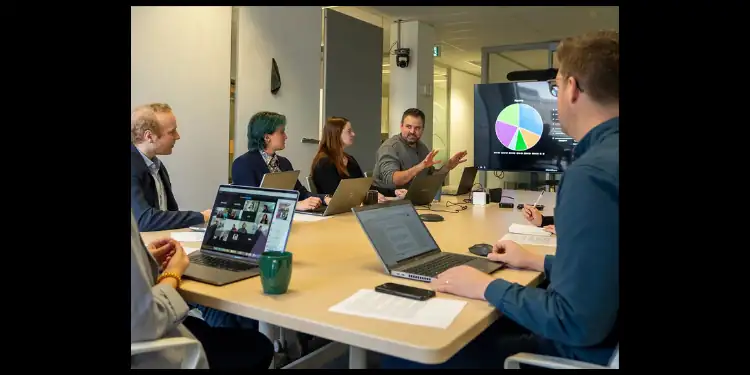
In collaboration spaces, inclusive AV design is becoming critical. Adaptive layouts, intuitive interfaces, and equitable audio-visual experiences ensure that remote participants feel just as present as those in the room. When thoughtfully implemented, experiential AV does not draw attention to itself; instead, it elevates the experience of being together, making interactions feel natural, engaging, and meaningful.
Innovation with Intent: Making ROI Human
As experiential AV becomes more prominent, organisations face a common challenge: how to innovate without over-investing in complexity. The most successful deployments begin not with technology, but with intent.
Rather than asking what systems to install, forward-thinking organisations start by defining outcomes. What types of interactions should a space enable? How should people feel after a meeting, a town hall, or a collaborative session? Once these questions are answered, technology decisions become clearer—and far more cost-effective.
A growing number of organisations are adopting modular AV strategies. Meeting spaces may begin with simple configurations, yet are designed to scale seamlessly into more sophisticated environments for all-hands events or executive communications. Unified control interfaces now allow employees to manage room settings, content, and displays without training, while template-driven content tools ensure brand consistency without the need for specialised creative teams.
When AV systems are intuitive, reliable, and purpose-built, they fade into the background. This is where true return on investment is realised—not in the hardware itself, but in the quality of human interaction it enables.
The Next Frontier of Workplace AV
Looking ahead, several key shifts are already redefining how AV will shape workplace engagement over the next three to five years.
First is the move toward software-defined, IP-centric workflows. Organisations are moving away from rigid hardware ecosystems in favour of flexible architectures that are easier to scale, update, and adapt as communication needs evolve.
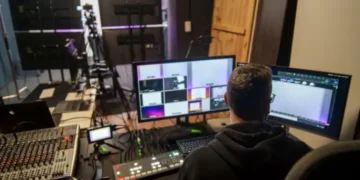
Second is the rise of broadcast-inspired corporate communication. Employees increasingly expect internal communications to match the quality and immediacy of live media. In response, many organisations are building in-house studios or transforming multi-purpose spaces to support polished, high-impact messaging.
Finally, there is a shift toward large-canvas thinking. Instead of treating displays as isolated endpoints, organisations are embracing unified visual environments—spanning walls, signage, and multi-functional spaces—to deliver storytelling that is fluid, immersive, and deeply connected to brand identity.
Together, these approaches aim to create consistency and quality across every touchpoint, whether someone is seated in a boardroom, joining remotely, or walking through a workplace. The future of AV will not be defined by equipment specifications, but by experiences that feel seamless, human, and emotionally resonant.
Enabling Workplace 3.0
Workplace 3.0 demands the same clarity, creativity, and immediacy that audiences now expect from live media. This is where Ross Video brings a distinct perspective—drawing on decades of expertise in broadcast production, real-time graphics, and immersive environments to elevate workplace communication.
Our focus is on empowering people, not overwhelming them with technology. We help organisations transform leadership messages into compelling narratives, hybrid meetings into inclusive experiences, and large-format displays into purposeful communication platforms. Flexibility is central to our approach: enabling organisations to start small, expand over time, and future-proof their spaces as expectations continue to evolve.
We have seen this journey play out across global enterprises—beginning with pilot implementations in regional offices and scaling across industries, from high-tech and finance to government environments. In each case, the workplace evolves into a communication hub: a place where culture is amplified, stories are shared, and people feel inspired to connect.
As the workplace continues to evolve, one thing is clear—technology alone will not define its success. Experiences will. And experiential AV, thoughtfully designed and human-centred, will be at the heart of Workplace 3.0.