



As the country begins to prepare for yet another year of negotiation with technology revolution, a truly massive platform was ‘programmed’ to map the algorithms of the matrix that appears to shape the year ahead.
Bengaluru, the tech capital of the country played centre stage for the show, Centre for Development of Advanced Computing (C-DAC) collaborated with Manipal Academy of Higher Education (MAHE) for the high-profile confluence of technology entrepreneurs and thought leaders for a four-day congregation.
………………………………………………………………
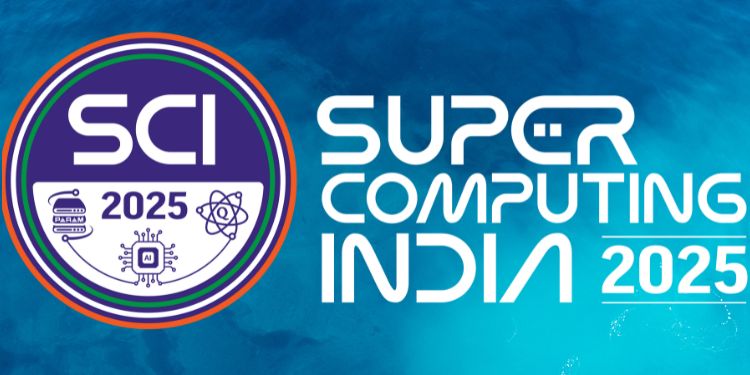
The inaugural ceremony of Supercomputing India (SCI) 2025, an international conference on high-performance computing (HPC), AI, and Quantum technologies took off at the Manipal Institute of Technology in Bengaluru on 9 December.
Organised by the Centre for Development of Advanced Computing (C-DAC) in association with MAHE, the four-day conference brought together a distinguished global community of experts, researchers, industry leaders, innovators, and academicians.
The inaugural ceremony was graced by the virtual participation of Minister of Electronics and Information Technology (MEITY) Ashwini Vaishnaw, and Union Minister of State MEITY Jitin Prasada. Both the ministers addressed the gathering through recorded messages, emphasizing the government’s commitment to technological advancement.
· India’s first Supercomputing India Summit kicks-off in Bengaluru· Over175 exhibitors showcase advanced computer technologies· Over 5,000 delegates from India and worldwide· Global leaders unite on HPC, AI, Quantum· Special programmes for women and young researchers |
The ceremony was also graced by several distinguished dignitaries that included S. Krishnan, Secretary, Ministry of Electronics and Information Technology; E Magesh, Director General, C-DAC; Dr. Hemant Darbari, Mission Director, National Supercomputing Mission (NSM); Dr. S. D. Sudarsan, Executive Director, C-DAC Bangalore; and Dr. Narayana Sabhahit, Pro Vice Chancellor – Technology and Science, MAHE, among others.

“This is India’s first global supercomputing conference and is a big milestone in our Deep Tech Journey; it’s a platform to showcase and share views about the advances in high performance computing, AI, quantum computing and semi-conductor technologies,” declared Ashwini Vaishnaw. “These are the fields which are redefining our economy and these are the technologies which are reshaping the entire world. We are focused on Made in India. Designed in India, and Made for the world solutions.”
The minister expressed his confidence that the conference would lead to increased global collaborations, stronger policy–industry alignment, and a significant boost to India’s innovation ecosystem.
Commending the “landmark moment in the nation’s journey through science and technology,” Jitin Prasada highlighted the government’s vision of Viksit Bharat 2047. “It is not merely a slogan, it is a vision of self-reliant, innovation driven that designs engineers and technologies of tomorrow,” he emphasized.
Keeping in line with the vision, the MEITY has been implementing transformative initiatives such as the National Supercomputing Mission, India’s Semiconductor Mission, India AI Mission, and Designing Initiatives.
Reflecting on MAHE’s contribution to boost India’s innovation ecosystem Dr. Narayana Sabhahit, Pro Vice Chancellor -Technology & Science, MAHE, noted that the institution is deeply committed to negotiate the frontier of Quantum Computing via its initiative THE Q-HUB@MAHE’s Bengaluru Campus.
According to him, the establishment of The Q-HUB — MAHE Quantum Centre at the Bengaluru campus is a powerful step toward realizing the vision of National Quantum Mission and fortifying India’s position in the global quantum ecosystem, which will house a 7-Qubit, extendable to 25-Qubit open-architecture facility. This centre also aims at integrating “Qniverse,” the indigenous quantum software developed by C-DAC.”
The event stood as a testament to the longstanding partnership between CDAC and MIT, as highlighted in the opening remarks by Shri E. Magesh, Director General, C-DAC. Some of the key areas of the partnership include capacity building through Faculty Development Programs at MIT and specialized HPC workshops. It also focuses on skill development via hands-on bootcamps on IoT device programming using indigenous technology. Additionally, the partnership provides researchers with direct access to C-DAC’s ‘Param Utkarsh’ supercomputing facility, enabling cutting-edge research in molecular simulations, AI, and other advanced areas.