


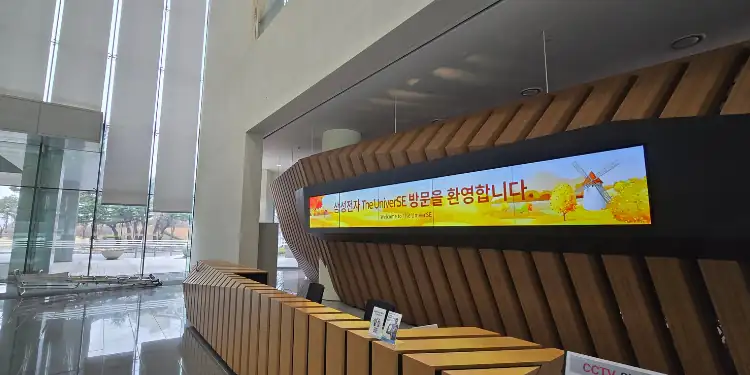
When Samsung’s UniverSE Training Center opened its doors in Yongin-si nearly 15 years ago, it stood as a benchmark for modern corporate education. Spread across two expansive buildings: a dedicated training facility and an adjoining dormitory. The campus housed around 70 classrooms and 60 lecture halls, each equipped with what was then state-of-the-art AV technology.
Time, however, has a way of exposing even the most forward-thinking designs. As digital workflows became the norm, UniverSE’s mix of analog systems and early digital devices began to show its age. What had once felt advanced slowly became restrictive, inefficient, and increasingly difficult to manage at scale.
 A Campus Outgrows Its AV
The most pressing limitation was fragmentation. Each classroom operated in isolation, unable to share audio or video with others. Adjustments and troubleshooting required staff to physically move from room to room, consuming time and resources. Although a central broadcasting room existed, it lacked the network infrastructure needed to monitor or control AV systems across more than 130 spaces.
The tipping point came when the training building, home to the broadcasting studio, required a major network upgrade. At that moment, centralised control, remote access, and seamless integration across the campus stopped being aspirational goals and became operational necessities.
To tackle the challenge, Samsung brought in system integrator Seoul Visual Tech. From the outset, it was clear that a simple refresh wouldn’t be enough. The project demanded a shift from disconnected, legacy AV to a cohesive, future-ready AV-over-IP architecture while adhering to strict budget constraints.
Designing for Scale, Flexibility, and Reality
The upgrade strategy unfolded in phases. The training building would retain much of its physical structure and selected AV hardware, but its underlying AV network would be completely rebuilt. Meanwhile, the dormitory building underwent full interior renovations, with new classroom spaces outfitted entirely with network-based AV systems.
Once complete, the project would connect more than 130 classrooms, making it one of the largest AVoIP integrations of its kind in South Korea.
Scale brought complexity. Product availability, firmware compatibility, and advanced configuration all had to be carefully managed. Budget pressures ruled out a full rip-and-replace approach, pushing the team toward a hybrid design that blended existing functional equipment with new, IP-based technology. Interoperability became a guiding principle—every device choice had to work not just on its own, but as part of a larger, evolving ecosystem.
The Dante-Powered Solution
At the heart of the new system is Dante AV, providing low-latency, high-quality video alongside audio over standard IP networks. Seoul Visual Tech designed a fully integrated AVoIP architecture that would deliver both performance and long-term flexibility.
Central to this design is Dante Domain Manager, which brings structure, security, and control to large-scale Dante networks. By segmenting the system into clearly defined domains, Samsung gained reliable performance, simplified organisation, and enterprise-grade management. Features such as user authentication, role-based access, real-time monitoring, and clock synchronisation now operate across four dedicated VLANs, giving the IT and AV teams full visibility and control.
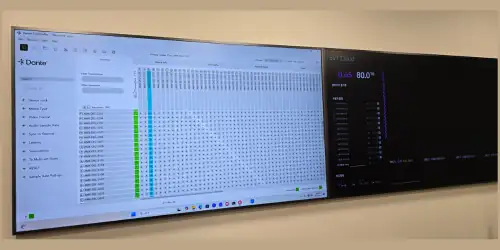
In the broadcasting room, a Q-SYS Core 610 DSP functions as the audio matrix, while AMX NMX 2600 Dante AV-A series encoders and decoders handle video distribution between classrooms. The network itself runs on Netgear AV Line switches, whose AV-focused interfaces make it easier to manage complex traffic flows without sacrificing reliability.
In total, more than 130 Dante AV-enabled video devices were deployed. An AMX control system oversees classroom power, device control, and AV routing, while API integration with Dante Domain Manager enables video routing to be managed directly within the custom control environment.
A New Way of Operating
The transformation was immediate. UniverSE now operates a modern, centrally managed AVoIP system capable of delivering stable, high-quality audio and video across the entire campus. Staff no longer need to walk room to room to troubleshoot issues; instead, operators can monitor and control every classroom from a single central hub in real time.
Beyond solving the original challenges, the new system unlocked efficiencies the team hadn’t initially anticipated. The IP-based design makes the infrastructure inherently scalable, allowing UniverSE to expand, reconfigure, or adopt new technologies without overhauling the entire system.
Setting the Stage for What’s Next
The success of the UniverSE Training Center has already had ripple effects. Seoul Visual Tech has since deployed Dante and Dante Domain Manager across multiple Samsung Semiconductor facilities and continues to explore more advanced Dante-based configurations for future projects.
For UniverSE, this wasn’t simply an AV upgrade, it was a campus-wide digital transformation. By balancing legacy realities with forward-looking design, and by focusing as much on user experience as on technology, the project delivered one of South Korea’s most sophisticated AVoIP infrastructures that has been built to support the students, instructors, and operators who rely on it every day.