





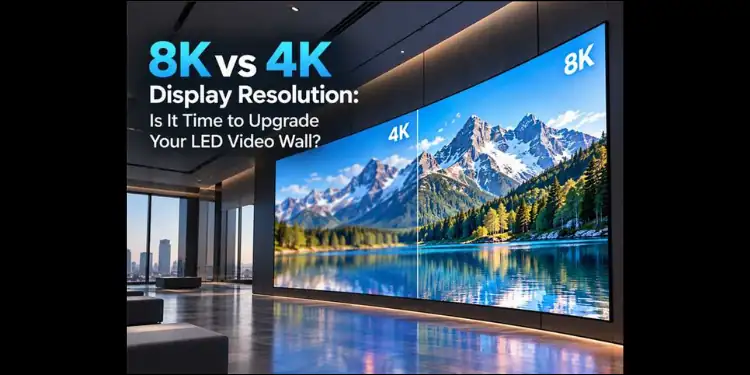
Commercial visual displays are shifting from HD and 4K toward 8K display resolution. Large-format display installations require significant capital investment and infrastructure planning. Decision makers must determine whether upgrading to an 8K Light Emitting Diode (LED) video wall provides measurable operational benefits or represents unnecessary technical specification.
8K vs 4K: The Core Technical Differences
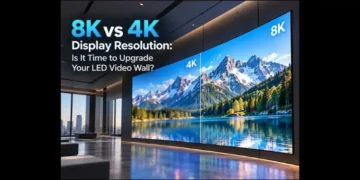
The distinction between 4K and 8K displays lies in total pixel count and spatial pixel density. A standard 4K display features a resolution of 3840 by 2160 pixels, which equals approximately 8.29 million pixels. An 8K display features a resolution of 7680 by 4320 pixels, totaling approximately 33.18 million pixels. This quadruples the image data available within the same physical surface area.
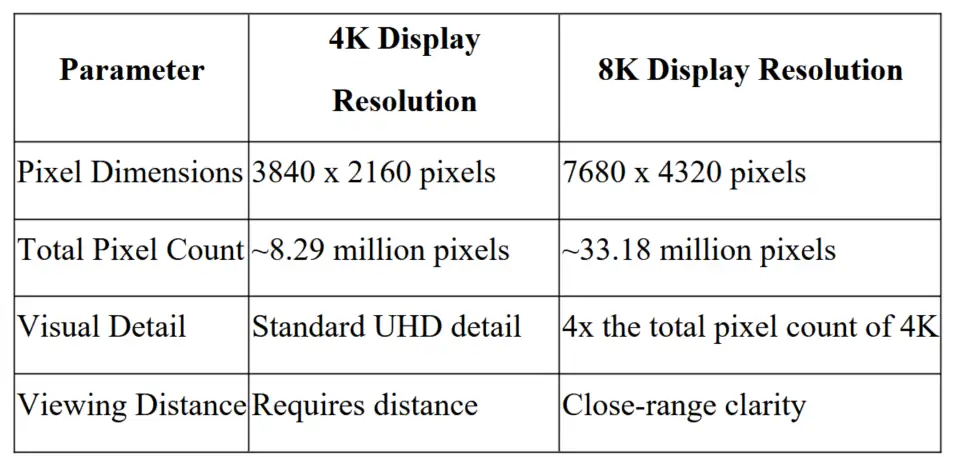 Higher pixel density eliminates the visible grid pattern between individual diodes, commonly known as the screen door effect. Consequently, curved lines, small typography, and subtle color gradients render with high smooth precision. Viewers standing within close range of an 8K surface observe continuous image structures rather than discrete LED packages.
Key Factors: When Does Upgrading to 8K Make Sense?
Upgrading to 8K display resolution becomes practical when specific physical and operational parameters align. Screen size and pixel pitch directly dictate whether an 8K configuration is physically achievable.
Spatial and Physical Requirements
With traditional large-pitch LEDs, reaching native 8K requires a physical wall size over 20 meters wide. Fine-pitch LEDs with pixel spacing under 1.0 millimeter allow native 8K configurations within standard boardroom dimensions.
Viewing Distance and Visual Comfort
Close viewing distances require higher resolution to maintain image structure. Command centers, broadcast studios, and executive suites place operators within 1 to 3 meters of large display surfaces. At these distances, individual pixels on 4K walls become visible, whereas 8K surfaces maintain image clarity without causing visual stress.
Multi-Window Data Density
Multi-window data display environments benefit directly from 8K resolution canvas sizes. Geographic Information System (GIS) mapping, financial monitoring, and security operation centers require continuous display of multiple data streams. An 8K wall can display four independent native 4K signals or sixteen native Full HD signals simultaneously without scaling down image clarity.
Overcoming 8K Technical Hurdles: How COB Technology Supports High-Resolution LED Video Walls
Implementing 8K display walls with Surface Mounted Device (SMD) packaging introduces technical limitations. As pixel pitch scales below 1.0 millimeter, individual SMD diodes become fragile and prone to mechanical damage during maintenance. High pixel density using traditional packaging also increases thermal generation and surface reflection, degrading contrast performance.
Chip-on-Board (COB) packaging addresses these mechanical and thermal challenges. COB technology attaches micro LED chips directly to the circuit board substratum and seals the surface with an epoxy resin layer. This design improves thermal dissipation efficiency, reduces heat buildup across high-density pixel arrays, and protects diodes from physical impact, moisture, and dust contamination.
The Architectural Choice for 8K LED Walls: LEDMAN QS Series
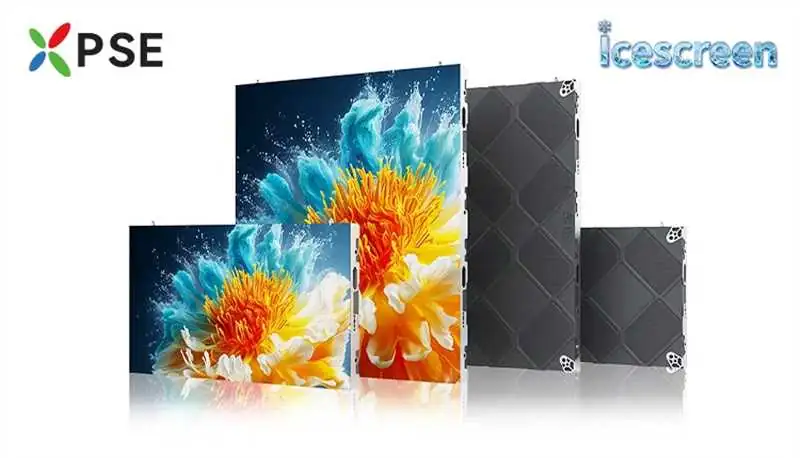
The LEDMAN QS Series Icescreen is designed for high-resolution LED video wall applications, supporting native 8K configurations with fine pixel pitch options below 1.0mm. Powered by LEDMAN‘s proprietary Pixel Share Engine (PSE) and AI-powered low-power technology, the QS Series combines outstanding image quality with energy efficiency. At 800 nits brightness, its screen surface temperature remains at or below 29.5°C after 30 minutes of operation, while the 7680Hz refresh rate ensures smooth and stable image performance. Featuring advanced COB packaging and integrated surface protection, the QS Series offers enhanced resistance to dust, moisture, and physical impact, making it a reliable solution for demanding professional display environments.
Conclusion
Choosing between 4K and 8K LED video walls ultimately depends on the specific application, viewing distance, screen size, and content requirements. Rather than pursuing resolution alone, businesses should prioritize display solutions that balance visual performance, energy efficiency, and long-term reliability. With its fine-pitch COB technology and AI-powered low-power performance, the LEDMAN QS Series Icescreen offers a compelling option for high-resolution indoor display applications, including native 8K installations.