





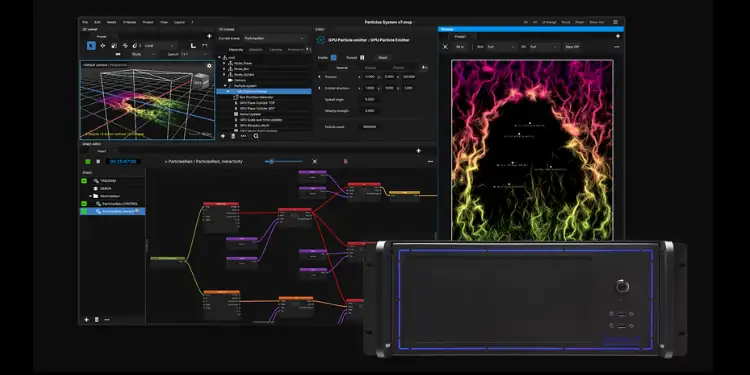
Ten years after the launch of Modulo Kinetic, Modulo Pi has unveiled Version 7 of its all in one media server platform, introducing a broad range of upgrades designed to simplify and accelerate immersive production workflows.
First launched in 2016, Modulo Kinetic has become widely adopted across projection mapping, live events, immersive venues, theme parks, and corporate productions, with hundreds of systems deployed globally. With Version 7, Modulo Pi is further expanding the platform’s capabilities by consolidating tools traditionally spread across multiple systems into a more unified production environment.
The new release introduces significant improvements across 3D design, projection studies, media playback, interactivity, and show control. One of the biggest additions is expanded native support for major 3D formats including Cinema 4D and SketchUp, alongside point cloud integration and built in prefab assets that allow users to design and prepare projects more efficiently within a single workflow.
Projection mapping capabilities have also been strengthened through full 3D projector modelling, including lenses and frames, refined editing tools, and direct 3D pre warping. An optional 3D auto calibration module further streamlines deployment by automating multi projector blending and warping processes, reducing setup time compared to traditional manual calibration methods.
Version 7 also introduces LED study and simulation tools for the first time, featuring an integrated database containing more than 2,000 LED panel models. This allows designers to simulate LED installations with accurate pixel pitch representation directly inside the platform.
To support increasingly interactive environments, Modulo Kinetic now includes 3D LiDAR simulation features that enable users to visualise sensor coverage, beam emissions, and environmental occlusions before installation. A new tracking and crowd simulation engine has also been added, allowing teams to test audience movement, interactive behaviours, and generative content scenarios in advance.
Media management workflows have also received upgrades, including expanded format compatibility, automated synchronisation with remote servers, and integrated content versioning to improve asset control across productions.
On the visual side, Version 7 introduces more than 150 new GPU powered effects capable of handling advanced real time treatments and live content processing with minimal latency. Interactivity features have also been expanded with spatially triggered playback, enhanced particle systems, and multi user generative effects that dynamically adapt based on audience participation.
The embedded show control environment has also been redesigned with updated interface tools, stronger user management features, and integration with ISAAC, a web based AV monitoring and control platform that enables centralised system management.
With the release of Version 7, Modulo Pi is positioning Modulo Kinetic as a more comprehensive platform for designers, integrators, and operators working on increasingly sophisticated visual productions and immersive experiences.